Global Sunroof Glass Supply Chain: Key Risks & Cost Optimization for Volume Buyers
With the continuous growth of automobile production and sales and the panoramic sunroof becoming the mainstream configuration of passenger cars, the purchasing scale of sunroof glass by bulk buyers continues to rise, and the stability of the supply chain and cost control directly affect the market competitiveness of end products, so it has become a core issue for mass buyers such as automakers and large refitting manufacturers.
Next, let’s first sort out several key risks hidden in the supply chain in the process of bulk purchasing sunroof glass.
The first is the risk of fluctuations in raw material supply. The core substrate of sunroof glass is float glass, and the production process of float glass is highly dependent on quartz sand, soda ash, and other bulk raw materials.

The supply stability and price trend of these raw materials are significantly affected by multiple factors such as the adjustment of mineral control policies, the change of logistics and transportation costs, and the fluctuation of energy prices.
Once there is a gap in the upstream supply chain, this impact will be directly transmitted to the processing and manufacturing of sunroof glass, which may not only lead to a temporary increase in procurement costs in a short period of time, but also hinder the production schedule due to the shortage of raw materials, and then delay the delivery, posing a potential threat to the smooth operation of the overall supply chain.
Secondly, it is about the risk of matching production capacity and delivery.
According to the specific design requirements of different models, the manufacturing of sunroof glass requires a number of customized technological processes, such as cutting, tempering, coating, and edging.
These technological processes have strict requirements on the accuracy level of production equipment and the consistency of technological processes. The production capacity of leading head suppliers in the industry is usually locked in advance by mainstream vehicle manufacturers to meet their large-scale and stable order demand.
In contrast, small and medium-sized batch purchasing customers or brands newly entering the market are often at a disadvantage when obtaining production capacity resources, which is prone to the phenomenon that the production capacity schedule is squeezed, which leads to the failure to catch up with the key time nodes of vehicle production on time and adversely affects the delivery schedule.
In addition, bulk sunroof buyers engaged in cross-border procurement business, they not only have to deal with conventional market fluctuations and supplier management challenges, but also have to bear a series of additional risks caused by geopolitical changes, cross-border transportation network congestion, and frequent adjustments to tariff policies.
These uncertain factors are often difficult to predict accurately in advance. For example, sudden changes in geopolitical policies may lead to trade bans or sanctions, thus making the original legal and compliant procurement contracts instantly invalid;
Congestion in cross-border logistics links may cause goods to stay in ports or transit stations, resulting in indefinite delay in delivery time, which will further affect the trust of downstream customers and order fulfillment;
However, tariff adjustment, whether raising tax rate or adding new taxes, will directly push up the total procurement cost, and even force buyers to re-evaluate the source of supply or adjust the quotation strategy.
It is precisely because these emergencies are uncontrollable that they will seriously disrupt the established procurement plan, forcing enterprises to frequently modify inventory strategies, re-plan transportation routes, or urgently find alternative suppliers.
These additional countermeasures will undoubtedly increase operational complexity and eventually form a large number of hidden costs in terms of capital occupation, manual operation, storage rent, and liquidated damages, and weaken the overall profit margin and market competitiveness of the procurement business.
After defining the core risks, bulk buyers can promote cost optimization from several dimensions.
Integration of sunroof procurement requirements
The scattered, sporadic, and non-uniform procurement plans are grouped into centralized management in order to achieve economies of scale.
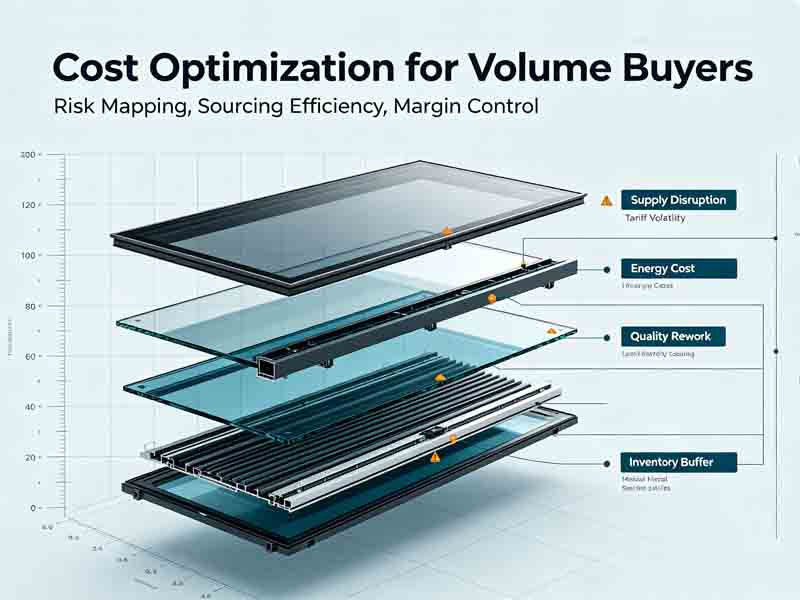
By collecting the purchase quantity and frequency in a unified way, we will sign a medium-and long-term framework agreement covering a long period (such as annual or inter-annual), so as to negotiate more competitive prices and superior commercial conditions for suppliers with stable purchase commitments, clear purchase volumes, and predictable cooperation continuity.
At the same time, with the effective constraints of the framework agreement, the capacity quota of suppliers in a specific period of time is locked in advance to ensure the priority and stability of supply.
This can not only effectively avoid the premium risk caused by temporary and urgent procurement, but also greatly reduce the communication cost, process cost, and uncertainty in the procurement process, thus improving the overall procurement efficiency and capital use efficiency.
Promote the localization layout of the sunroof supply chain
In the surrounding areas of the target sales market, systematically screen and identify sunroof glass suppliers with corresponding qualifications and capabilities as an important strategy for the supply chain layout.
This measure can significantly reduce the logistics costs caused by long-distance transportation and, at the same time, effectively avoid the tariff barriers involved in cross-border trade, thus greatly reducing the overall procurement costs.
In addition, selecting sunroof suppliers with geographical proximity can obviously shorten the period from ordering to delivery, improve the response speed to market demand, and enhance the flexibility and stability of the supply chain, thus reducing the risk of supply interruption or delay caused by changes in the external environment.
Optimize inventory control
Based on the actual production plan and the specific delivery cycle of suppliers, the dynamic adjustment safety inventory mechanism is systematically established.
This mechanism can not only effectively avoid the excessive occupation of working capital due to excessive stocking, but also effectively prevent the smooth progress of the overall production schedule from being affected by supply interruptions.
In addition, for customers who purchase in bulk, they can also build a reasonable supplier competition pattern by actively introducing a second alternative supplier.
In this way, it can not only ensure the stability of the supply system but also reserve flexible and sufficient space for subsequent cost negotiations, thus further enhancing the overall resilience and economic benefits of the supply chain.
FAQ
Q: What is the minimum order quantity for purchasing sunroof glass in bulk?
A: The order quantities of different suppliers are quite different. Head suppliers usually require a single order quantity of ≥ 5,000 pieces, and small and medium-sized suppliers can be as low as 1,000 pieces. When purchasing, they can negotiate flexibly according to their own needs. Long-term cooperative customers often get lower order quantities.
Q: What are the special requirements for the packaging and transportation of sunroof glass?
A: It needs to be packed in custom-made wooden cases with shock-proof cushioning, and the individual glasses are separated by PE film to avoid stacking pressure during transportation. Long-distance sea transportation requires additional moisture-proof layers, and suppliers are required to purchase freight insurance to reduce the risk of damage.
Q: When purchasing sunroof glass in bulk, how to deal with the risk of rising costs caused by fluctuations in raw material prices?
A: We can sign a framework agreement with core suppliers to lock in the price for a long time, stipulate a reasonable range of price fluctuation, and avoid the cost impact caused by the sharp price increase of raw materials in a short period of time. At the same time, we can also combine our own inventory control ability to appropriately increase stocking when the price of raw materials is low, so as to reduce the overall procurement cost.