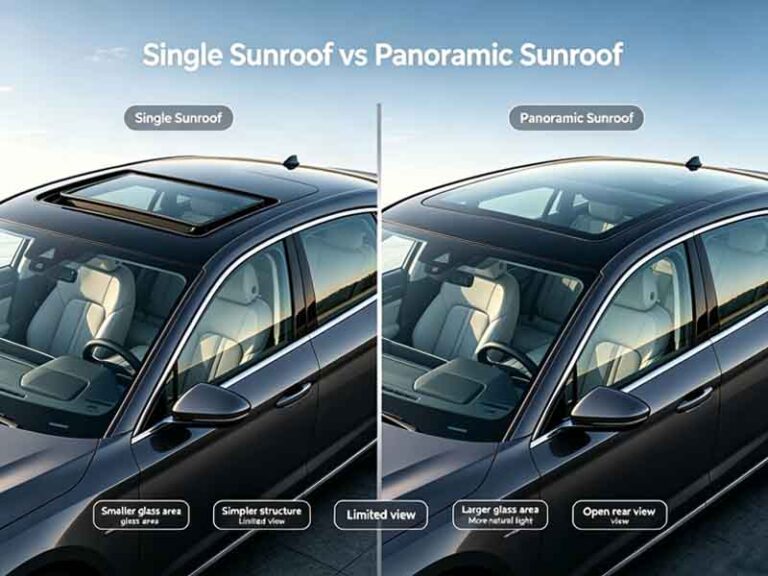
Auto Sunroof and Moonroof Market Demand Trends
In recent years, the global auto sunroof and moonroof market has been upgraded in the direction of personalization and comfort, and consumers’ requirements for travel experience have been continuously improved, which has promoted the market demand for automobile sunroofs and moonroofs to continue to grow.
On the consumer side, entry-level models gradually increase the proportion of sunroof configurations. Mid-range and above models list the moonroof as a core standard feature, and more consumers are willing to pay extra for a more transparent cabin and a more natural driving experience.
Iteration of moonroof technology: from mechanical structure to electronic integration
Moonroof has become the absolute main force in the current automobile sunroof market, and its technical upgrading direction is evolving from the traditional mechanical slide rail structure to a highly electronic and integrated direction.
Ultra-large integrated glass is the most significant technical trend at present. Traditional sunroofs are limited by body rigidity and manufacturing technology, and usually adopt a segmented design.
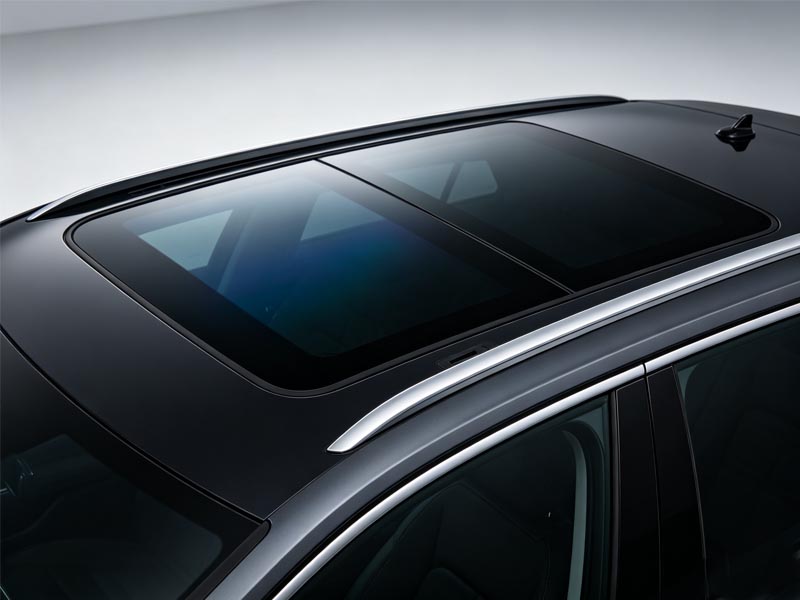
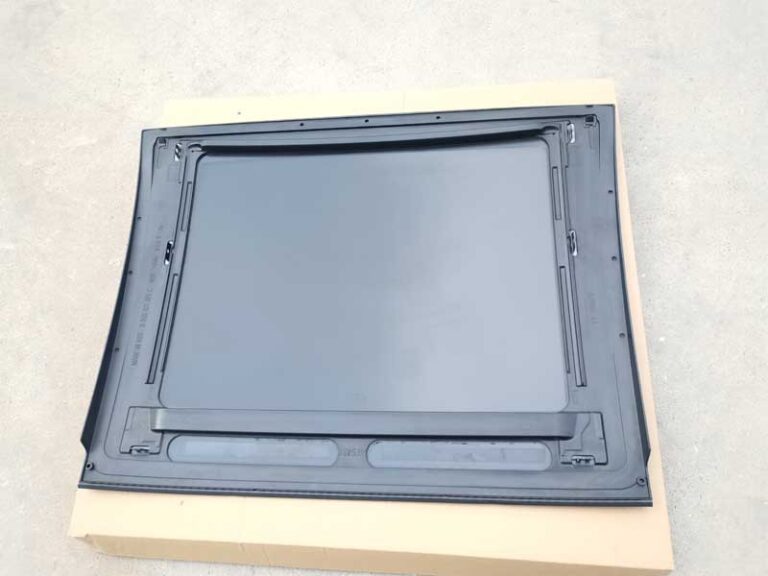
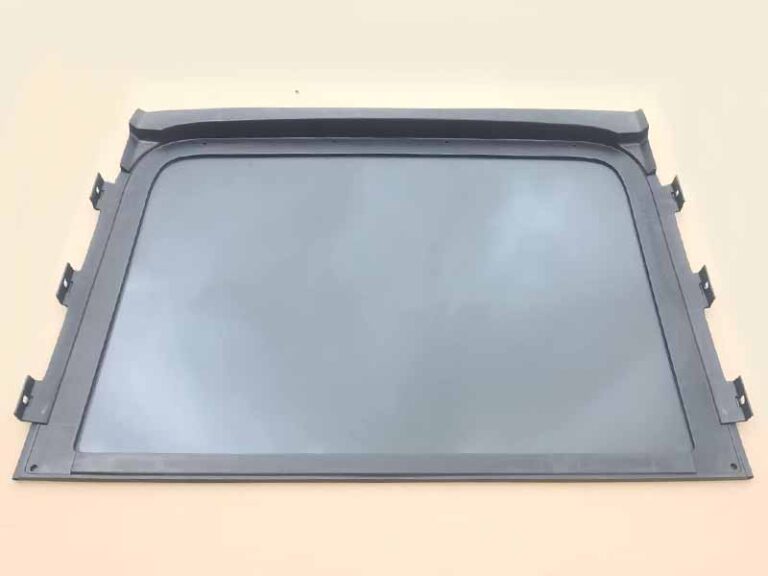
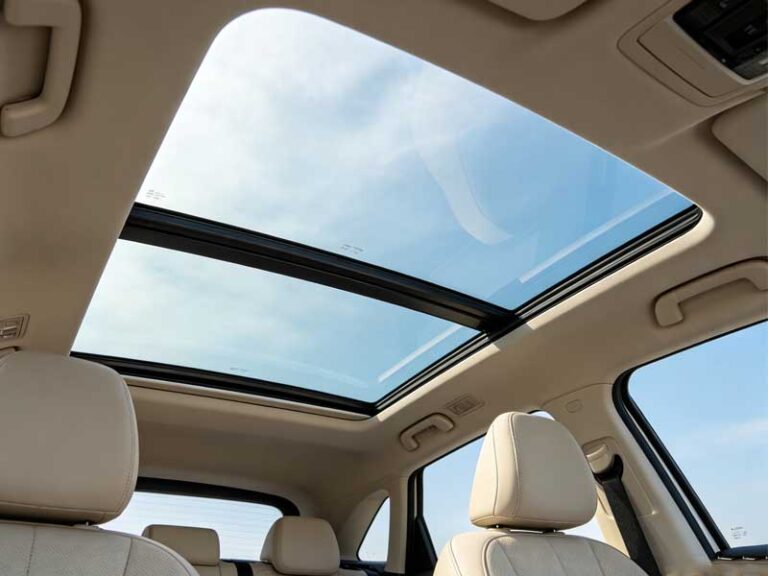
The new-generation panoramic canopy adopts an integrated super-large glass panel with an area of 2-3 square meters, covering the entire roof and providing unparalleled transparency for passengers. Behind this is the comprehensive upgrade of glass hot bending and forming, tempering treatment, and the mechanical design of the car body structure.
Openable and fixed double-track parallel. The openable moonroof has achieved more precise motor control and an anti-pinch algorithm at the technical level, and supports multiple modes such as multi-stage opening and inclined ventilation.
Some high-end models have realized voice-controlled sunroof opening and closing. The fixed panoramic canopy further releases head space by eliminating the mechanical opening and closing mechanism, reducing system complexity, and improving the vehicle’s sealing and NVH performance.
Ambient light effect integration has become a new bright spot in sunroof technology. LED light guide bars are embedded in the edge or inside the sunroof glass, which supports functions of multi-color adjustment, a breathing light effect, and linkage with music rhythm, upgrading the sunroof from a functional component to an important carrier for creating cockpit atmosphere.
Some models even featured the direct display of starry sky patterns or brand logos on the sunroof glass surface, which greatly enhanced the sense of technology and luxury of the cockpit.
Lightweight and application of new materials: weight reduction and performance improvement of the sunroof
The extreme pursuit of cruising range for new energy vehicles has promoted the rapid development of sunroof lightweight technology.
The weight of a traditional moonroof assembly can reach tens of kilograms, which has a significant impact on vehicle endurance and handling. Lightweight has become one of the core topics in sunroof design.
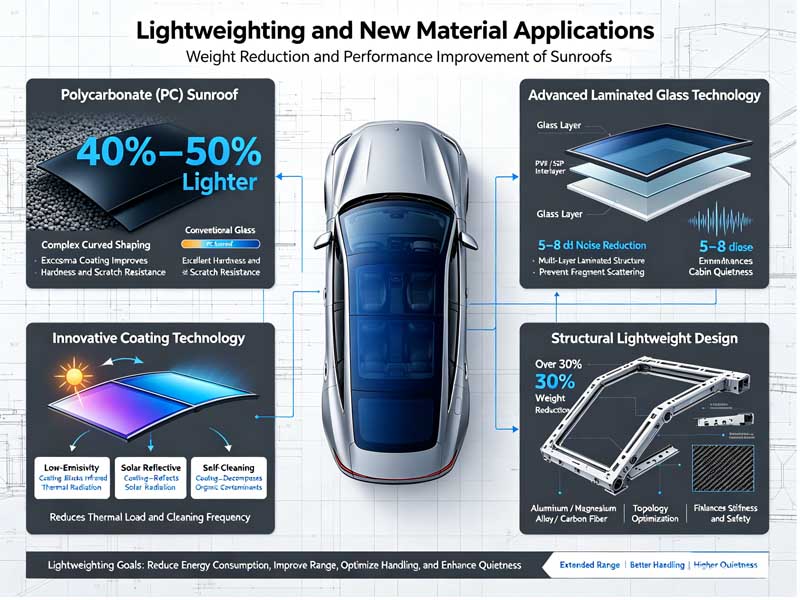
Polycarbonate (PC) sunroof is an important direction of lightweight. Compared with the traditional glass sunroof, polycarbonate material can reduce weight by 40%-50%, and at the same time, it has excellent impact resistance and design freedom and can be molded into complex curved surfaces.
The surface of the new-generation PC sunroof adopts plasma coating technology, and its hardness and scratch resistance are close to the glass level; it also has ultraviolet blocking function.
The EU market is driven by carbon emission regulations, and the adoption rate of PC sunroofs in new energy vehicles has increased significantly.
Technical upgrade of laminated glass. High-end sunroofs generally adopt a multi-layer laminated glass structure, and PVB or SGP intermediate film is embedded between the two layers of glass, which not only improves the sound insulation performance but also prevents debris from splashing when the glass is broken.
A new generation of acoustic laminated glass can reduce the noise in the car by 5-8 decibels and significantly improve the quietness of the cockpit.
Innovation in coating technology. Advanced coating technologies such as low-radiation coating, solar reflective coating, and self-cleaning coating are being accelerated in the field of sunroofs. Low-emissivity coating can effectively block infrared thermal radiation and reduce cabin heat load;
Solar reflective coating can reflect most of the solar radiation energy back to the atmosphere; Self-cleaning coating uses the photocatalytic principle to decompose organic pollutants on the glass surface and reduce the cleaning frequency of the sunroof.
Lightweight design of the structure. Sunroof frame materials are evolving from traditional steel to aluminum alloy, magnesium alloy, and carbon fiber composite materials.
At the same time, the application of topology optimization algorithms and finite element analysis technology enables the sunroof structure to achieve ultimate weight reduction while ensuring stiffness and safety.
The weight of the sunroof assembly of some leading enterprises has been reduced by more than 30% compared with five years ago.
Integration of intelligence and cockpit ecology: sunroof becomes a new interactive interface
Sunroof is evolving from a single “roof opening” to an important part of intelligent cockpit ecology, which is deeply integrated with the electronic and electrical architecture of the whole vehicle and becomes a new interface for human-vehicle interaction.
Linked with intelligent driving system. The sunroof control unit is connected with ADAS sensing system, which can realize scene automatic adjustment.
Voice and gesture control. The new-generation sunroof system supports natural voice control, and some models also introduce gesture control technology. Users can control the opening, closing, and dimming by waving gestures under the sunroof, which further enhances the convenience of operation and the sense of technology.
OTA remote upgrade. The control algorithm and scene strategy of the intelligent sunroof can be continuously optimized through OTA aerial upgrades.
Car companies can unlock new sunroof functions for users through software updates after delivery, such as a new starry sky mode, a new automatic dimming strategy, and linkage with third-party applications. This “hardware embedded+software defined” mode makes the sunroof become an evolvable intelligent component.
Solar sunroof technology. By integrating high-efficiency solar cells on the roof, the sunroof can use solar energy to charge the auxiliary battery of the vehicle when parked or supply power to the cockpit ventilation system, so as to reduce the temperature inside the vehicle in summer.
The conversion efficiency of the new-generation solar sunroof has exceeded 20%, and some schemes have also realized the integration of translucent solar cells and dimming functions, taking into account the power generation efficiency and light transmission requirements.
The sunroof cooperates with the cockpit thermal management system. The intelligent sunroof is linked with the air conditioning system and seat ventilation system, which can automatically adjust the light transmittance of the sunroof according to the temperature distribution of the cockpit, and realize “zonal thermal management”.
For example, in summer, the sunroof on the direct sunlight side is automatically dimmed to reduce local heat radiation, and the air conditioning system is used to realize the uniform distribution of cabin temperature, which improves ride comfort and reduces energy consumption.
FAQ
Q: Can suppliers provide customized sunroof solutions?
A: Head suppliers can provide customized services from design to mass production according to vehicle structure and brand positioning.
Q: How long is the lead time for sunroof suppliers?
A: The lead time of standardized sunroofs is about 30-45 days, and customized products need to be adjusted according to the development difficulty, generally 60-90 days.
Q: How can suppliers ensure the long-term reliability of sunroofs?
A: Regular suppliers will pass 100,000 opening and closing tests, high and low temperature environment tests, corrosion resistance tests and other multi-dimensional reliability verification.