Top 5 Auto Sunroof Failure Modes and How Suppliers Can Prevent Them
As the core component of auto appearance and comfort, the sealing reliability and running stability of an auto sunroof directly affect the driving experience and vehicle quality.
However, automobile sunroofs need to be used in complex working conditions such as high temperature, high humidity, wind, and sand turbulence for a long time. After many rounds of switching cycles, temperature alternation, and rain and dust erosion, various functional failures often occur.
For parts suppliers, if the common failure modes of sunroofs can be accurately identified, the failure causes can be locked in advance, and the preventive mechanism can be established; the after-sales failure rate can be reduced at the source, and customer satisfaction and product market competitiveness can be improved.
- First, The Auto Sunroof Leaks
- Second, the Sunroof is abnormal, the invisible killer that affects the driving quality
- Third, the sunroof is stuck or cannot be opened and closed normally, which is the core problem of functional failure
- Fourth, the sunroof glass is broken, a double risk of safety and cost
- Five, Sunroof motor and electronic module failure-the weakness of the intelligent era
First, The Auto Sunroof Leaks
Failure performance
The leakage of an automobile sunroof is the most complained-about problem by end users, which usually shows that rainwater seeps into the car along the edge of the ceiling, which seriously leads to moldy interior of the ceiling and short circuit of electronic modules. Water leakage is often not a one-time outbreak, but gradually appears with the passage of time.
Basic Reason
Blocked or bent drainage pipe: dust, leaves, insects, and other debris enter the drainage pipe, resulting in poor drainage.
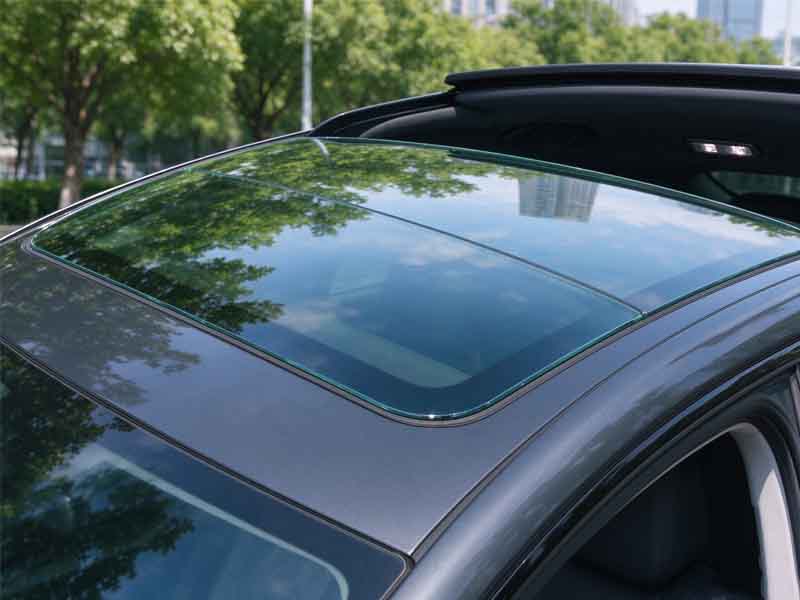
Aging or improper installation of sealing strip: EPDM or TPE sealing strip loses elasticity under long-term ultraviolet irradiation and temperature alternation.
Out-of-tolerance flatness between sunroof frame and body mounting surface: uneven compression of sealing strip.
Micro-cracks appear in the adhesive layer between the glass and frame.
Supplier preventive strategy
1. Before leaving the factory, the sunroof of the car was tested with 100% rain, simulating the rain conditions at different angles and pressures.
2. Optimize the drainage pipe design to avoid sharp turns and too small an internal diameter (recommended internal diameter> 6 mm).
3. Choose a silica gel-based sealing strip with better weather resistance, and pass the high and low temperature cycle test from -40℃ to +100℃.
4. Measure the mounting surface of the frame with three coordinates to ensure that the flatness tolerance is controlled within 0.5 mm.
5. Add anti-extrusion support structure in packaging and transportation links to prevent the frame from deforming.
Second, the Sunroof is abnormal, the invisible killer that affects the driving quality
Failure performance
Abnormal sound of the automobile sunroof is the second-largest complaint type after water leakage, which is manifested by creaking, rubbing, or bumping sounds in the sunroof area when the vehicle is driven on a bumpy road. The problem of abnormal sound is subjective, difficult to reproduce, and has high maintenance costs, which is particularly harmful to brand reputation.
Basic Reason
The fit clearance between the guide rail and the slider is too large or too small.
Grease is dry, deteriorated, or unevenly coated.
The buffer gasket between the glass and the frame is missing or aging.
The difference in thermal expansion coefficient between metal parts leads to relative displacement when the temperature changes.
The mounting point between the sunroof assembly and the roof is not rigid enough.
Supplier preventive strategy
1. Establish the gap control standard between the guide rail and the slider, and recommend that the fit gap be controlled at 0.1-0.3 mm.
2. Choose long-life lubricating grease (such as composite lithium-based grease containing molybdenum disulfide) and standardize the grease coating amount and coating position.
3. A wear-resistant buffer gasket is added to the contact surface between the glass and frame, and PTFE or nylon is recommended as the material.
4. Conduct an abnormal sound test in the whole temperature range (-30℃ to +80℃), covering extreme climatic conditions.
5. Optimize the design of the mounting point and add a rubber damping washer to absorb high-frequency vibration.
Third, the sunroof is stuck or cannot be opened and closed normally, which is the core problem of functional failure
Failure performance
The auto sunroof is stuck in the process of opening or closing, stops halfway, cannot be completely closed, or cannot be opened. In severe cases, the motor idles, but the sunroof does not move, or the anti-pinch function is mistakenly triggered, resulting in repeated rebound of the sunroof.
Basic Reason
The guide rail is deformed, or there are foreign bodies such as burrs and welding slag.
Insufficient motor output torque or gear wear.
The sensitivity calibration of the anti-pinch control module is unreasonable.
The steel wire cable or flexible shaft is broken and out of the groove.
Long-term lack of maintenance leads to dust accumulation and scaling on guide rails.
Supplier preventive strategy
1. Add deburring and cleaning procedures to the guide rail after machining to ensure that the roughness Ra of the moving surface is ≤ 1.6μ m.
2. The motor is tested for load durability before leaving the factory, and it is recommended to pass the verification of more than 10,000 full-stroke opening and closing cycles.
3. The calibration of anti-pinch force strictly follows the ECE R21 or GB 11552 standard, and a safety margin of 10%-15% is reserved.
4. The steel cable is made of stainless steel and the surface coating is added to reduce the friction coefficient.
5. With the maintenance guide attached to the product, users are advised to clean and lubricate the guide rail once every six months.
Fourth, the sunroof glass is broken, a double risk of safety and cost
Failure performance
The sunroof glass suddenly cracks or breaks in normal use, which may be caused by temperature stress, installation stress, or foreign body impact. Glass breakage not only involves high replacement cost, but also has potential safety hazards.
Basic Reason
There are manufacturing defects such as bubbles and impurities in the glass.

The residual stress distribution of tempered or laminated glass is uneven.
When installing, the pretension between the glass and the frame is too large, resulting in local stress concentration.
Micro-cracks occur at the edge of glass during cutting or edging.
When the vehicle is exposed to extreme temperature differences (such as sudden cold water after exposure), the glass thermal shock fails.
Supplier preventive strategy
1. The glass original supplier must pass IATF 16949 certification and provide bubble and impurity detection reports for each batch.
2. For a 100% stress uniformity test of tempered glass, a polarized light stress meter is recommended.
3. Formulate standardized glass installation torque specifications, recommend using fixed torque tools and record torque values.
4. Chamfering and polishing procedures are added to the glass edge to eliminate the source of microcracks.
5. Carry out a thermal shock test (spraying 0℃ cold water directly from a +85℃ environment) to ensure no cracks.
Five, Sunroof motor and electronic module failure-the weakness of the intelligent era
Failure performance
With the increasingly intelligent sunroof function (one-button opening and closing, anti-pinch, rainfall-sensing closing, voice control, etc.), the proportion of electronic system failures has increased year by year. Common manifestations include the motor not responding to instructions, failure of the anti-pinch function, loss of position sensor signal, water burning of the control module, etc.
Basic Reason
Motor carbon brush wear or commutator surface ablation
Insufficient waterproof rating of the control module, condensed water, or water leakage leads to a short circuit.
Hall sensor or limit switch signal drift
Poor contact of the harness connector or oxidation of the terminal.
Software logic defects lead to misjudgment of the anti-pinch algorithm
Supplier preventive strategy
1. The motor is made of long-life carbon brush material, which has been verified by 20,000 durability tests.
2. The protection level of the control module should reach at least IP5K2 (dustproof and drip-proof), and IP6K7 (short-time immersion) is recommended.
3. A redundancy check mechanism is added to the sensor signal to prevent abnormal function caused by a single-point failure.
4. The wiring harness connector is waterproof (with a sealing ring), and the plugging force is tested before leaving the factory.
FAQ
Q: Is the leaking sunroof a product quality problem?
A: Not necessarily. Drainage pipe blockage is a common cause, so it can be cleaned regularly. However, if the new car leaks water, it is a seal or frame installation defect, and the supplier should bear the warranty responsibility.
Q: Will abnormal sunroof noise affect driving safety?
A: It usually does not affect safety, but it will seriously affect the driving experience and brand reputation. It is suggested to check the lubrication or installation clearance of the guide rail as soon as possible to avoid the abnormal sound.
Q: What should I do if the sunroof anti-pinch function fails?
A: First, check whether there is a foreign body stuck in the guide rail, and secondly, it may be a sensor calibration deviation. It is suggested that the supplier calibrate the anti-pinch force before leaving the factory and reserve the self-learning function.