Auto sunroof glass: 2026 Global Supply Trends for Bulk Buyers
Automobile sunroof glass is an important part of automobile production. For global bulk buyers, accurately grasping the supply trend in 2026 will help optimize purchasing decisions, control costs, and ensure the stability of the supply chain.
Next, the Houming sunroof will be analyzed from several core directions: supply pattern, raw material influence, regional supply changes, and procurement risk.
Sunroof glass technology upgrades drive demand structure differentiation, and the proportion of customization increases.
The electrification and intelligent transformation of the automobile industry is pushing the functions of automobile sunroof glass products to upgrade from traditional ventilation and light transmission to intelligent dimming, solar power generation, integrated sensors, and other composite functions, driving the demand structure of automobile sunroof glass to continue to differentiate, and the order structure of bulk purchases has also changed.
In the past, standardized universal size products occupied the absolute mainstream of bulk procurement, and now the proportion of customized sunroof glass orders for specific vehicle platforms is increasing year by year.
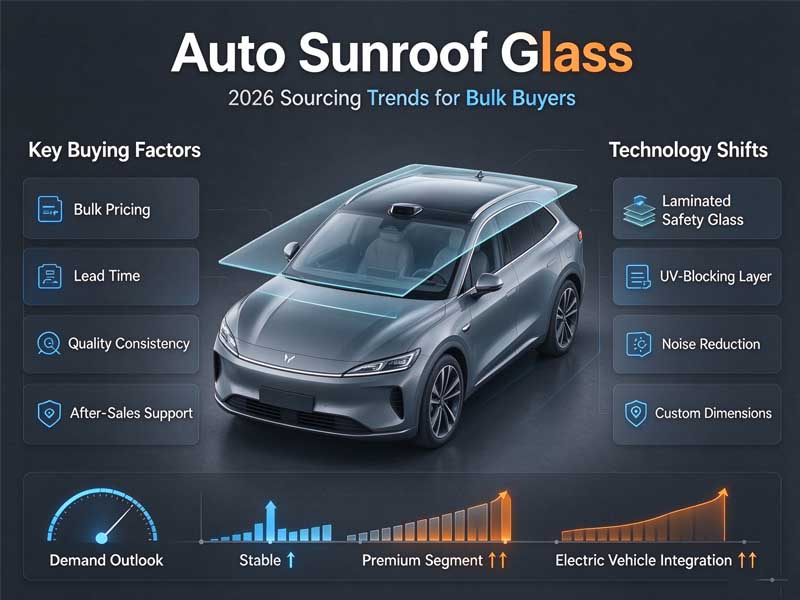
This change puts forward new requirements for both buyers and suppliers. For buyers, it is necessary to synchronize the vehicle development plan with suppliers in advance and intervene in technology docking at the product design stage to ensure the adaptability and mass production of customized products.
For suppliers, it is necessary to have full-process service capability from design and development, mold opening and proofing, to mass production, and be able to respond to the customization needs of different buyers while maintaining the efficiency and quality stability of mass production.
In addition, continuous improvements in panoramic sunroof permeability have also increased resistance, sound insulation, and heat insulation performance. Only suppliers with mature mass production technology and a quality control system can meet the batch quality requirements of large buyers.
Sunroof Glass Lightweight and material innovation: an irreversible industrial need
Driven by the goal of “double carbon” and the endurance race of new energy vehicles, the lightweighting of sunroof glass has evolved from a technical trend to an irreversible industrial need. In 2026, ultra-thin high-strength glass, composite frames, and frameless panoramic canopy designs are accelerating to become mainstream solutions.
As a key functional component of the roof system, the sunroof system’s self-weight is directly related to the energy efficiency rating and endurance performance of the whole vehicle.
From the perspective of material selection, laminated glass is gradually expanding its market share in the field of panoramic sunroofs with its excellent safety performance, acoustic performance, and functional integration potential.
PVB intermediate film can not only effectively prevent fragments from splashing when glass is broken, but also integrate heat insulation, sound insulation, and even solar energy absorption functions.
At the same time, some suppliers have begun to lay out ultra-thin laminated glass schemes with a thickness as low as 1.6 mm, and have achieved remarkable weight reduction effect on the premise of ensuring impact resistance.
For large buyers, the introduction of lightweight materials needs to be synchronized with the structural design of the whole vehicle, rather than simple material replacement.
This means that the front-end collaborative R&D capability of suppliers becomes crucial, suppliers who can participate in the early definition of vehicle models and optimize glass parameters and installation schemes according to the structure of the white body will have stronger cooperation value than manufacturers who simply provide standardized products.
Sunroof Suggestions on purchasing strategy: a future-oriented supplier evaluation framework
Based on the supply trend in 2026, when evaluating the suppliers of sunroof glass, large buyers suggest building a systematic evaluation framework from the following four dimensions:
First, technology research and development and customization capabilities. Whether the supplier has the ability to research and develop synchronously with the automobile factory, and whether it can quickly adjust the glass parameters and process scheme according to the vehicle design requirements, are core indicators for measuring its overall strength.
Especially in the field of intelligent dimming and lightweighting, the depth of suppliers’ technical reserves directly determines the ceiling of cooperation.
Second, the quality certification system and quality control process. Sunroof glass involves driving safety and must meet the mandatory certification standards of the target market.
The purchaser shall focus on verifying the IATF 16949 quality management system certification of the supplier, as well as compliance with the safety laws and regulations of the corresponding market, including American FMVSS 205/216, European ECE R43, and China GB 9656.

At the same time, on-site or entrust a third party to verify the control standards of the supplier’s raw material inspection, process sampling inspection, and complete inspection of finished products to ensure the product consistency meets the requirements.
Third, the production capacity layout and delivery stability. Whether suppliers have localized production capacity in the core market is directly related to the timeliness of order delivery and logistics costs.
It is suggested that suppliers with production bases around major vehicle manufacturing clusters should be given priority to reduce the risk of supply interruption caused by geopolitical and logistics fluctuations.
Fourth, full link service capability. The leading supplier in 2026 is no longer limited to product delivery, but extends to front-end collaborative research and development and a localized after-sales network.
Suppliers who can provide pre-positioned technical support services and deploy local warehouses and after-sales teams in core overseas markets will have significant advantages in service response speed and customer experience.
Finally, supply chain resilience is still the focus of bulk purchasing in 2026, and potential risks such as geopolitical conflicts and logistics congestion will still affect global supply. It is suggested that bulk buyers plan alternative supply channels in advance to reduce the risk of supply interruption caused by single-source dependence.
FAQ
Q: What are the main types of sunroof glass?
A: At present, the mainstream sunroof glass is divided into toughened glass and laminated glass. Tempered glass has a low cost and is mostly used in traditional small sunroofs. Because of its better safety, sound insulation, and functional integration, laminated glass has become the first choice for panoramic sunroofs and intelligent dimming ceilings, and its market share continues to increase.
Q: How long does the supplier’s sample verification cycle usually take?
A: It usually takes 8 to 12 weeks from technical docking and mold development to sample delivery, depending on the dimensional complexity, functional integration, and whether it is necessary to customize core materials such as dimming film. Buyers are advised to start the supplier sample process as early as possible at the project establishment stage.
Q: What is the minimum order quantity of sunroof glass?
A: The minimum order quantity varies with suppliers and product types. Standardized tempered glass products are usually ordered in thousands, while customized intelligent dimming sunroofs or special-shaped panoramic canopies have a relatively high order threshold because it involves special molds and process debugging. It is suggested that buyers should make clear the ladder quotation and ordering conditions with suppliers at the inquiry stage.