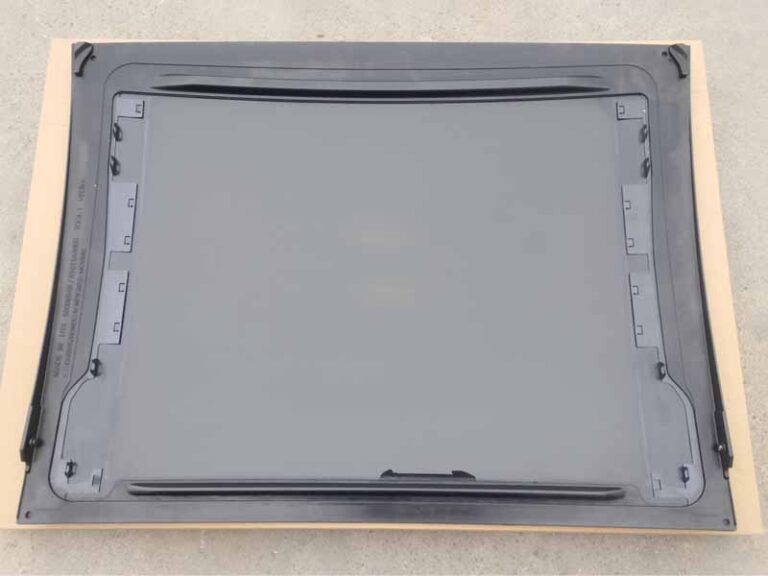
5 Critical Quality Tests Every Car Sunroof Glass Buyer Should Demand
As a purchaser of automobile sunroof glass, product quality directly determines downstream customer satisfaction, brand reputation, and even driving safety. Before bulk purchasing, suppliers must be required to complete five core quality tests to fundamentally avoid potential risks.
- Impact test: simulating the impact resistance of extreme scenes
- Sunroof Optical performance test: ensuring driving vision and comfort
- Sunroof Weathering test: stability against extreme weather
- Mechanical performance test: structural strength and installation reliability
- Sunroof Glass Chemical resistance test: the ability to resist corrosion and pollution
Impact test: simulating the impact resistance of extreme scenes
The biggest threat that the sunroof glass faces in daily use comes from external impacts- falling objects, hail, splashing stones, and even squeezing when the vehicle rolls. Impact resistance is the first line of defense for measuring the safety of sunroof glass.
The falling ball impact test is the core index for measuring the anti-external impact performance of sunroof glass, which is directly related to the ability to deal with unexpected situations such as flying stones and hail during vehicle driving.
The test should strictly follow the ISO 12543 standard. A steel ball with a diameter of 63.5mm and a weight of 1,040 g will fall freely from a height of 1 meter onto the central area of the glass, and observe whether the glass cracks, breaks, or falls off.
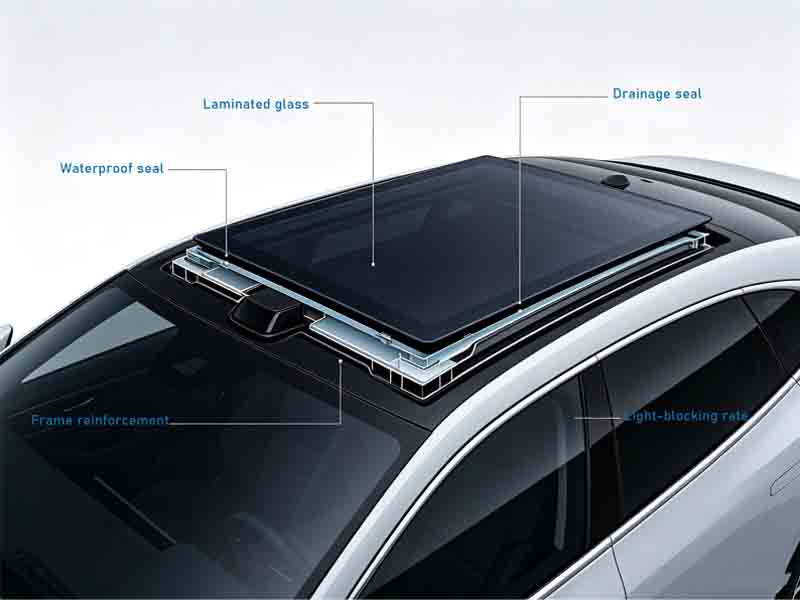
Qualified sunroof glass should be kept intact after the test, and only tiny cracks are allowed, but they can’t penetrate, so as to ensure that they won’t cause secondary injury to people in the car in extreme cases.
Sunroof Optical performance test: ensuring driving vision and comfort
The optical performance of sunroof glass directly affects the driving experience and safety, mainly including three core indices: transmittance, ultraviolet blocking rate, and thermal insulation rate.
According to the GB 9656 standard, the light transmittance of the front windshield should be above 70%. Although sunroof glass is not mandatory, the light transmittance of high-quality products should be no less than 85%, the ultraviolet blocking rate should be above 99%, and the heat insulation rate should be no less than 60%.
Insufficient light transmittance will lead to dim light in the car and increase the driver’s visual fatigue; a low ultraviolet blocking rate will accelerate the aging of the interior and endanger the health of drivers and passengers;
Insufficient heat insulation will lead to high temperatures in the car and increase the energy consumption of air conditioning.
The purchaser shall require the supplier to provide professional optical instrument test reports and observe the glass for bubbles, impurities, or optical distortion with the naked eye during sample acceptance to ensure clear vision without interference.
Sunroof Weathering test: stability against extreme weather
Automobile sunroof glass is exposed to the outdoor environment for a long time, and it needs to withstand multiple tests such as high temperature, low temperature, humidity changes, and ultraviolet radiation. Weather resistance testing is key to ensuring the service life of products.
The test needs to simulate different climatic conditions, put the glass in the environment of -40℃ to 80℃ for repeated circulation, and simultaneously carry out ultraviolet irradiation and condensation spraying for at least 1000 hours.
Qualified products should have no obvious discoloration, cracking, or peeling phenomenon after testing, and the decline of various performance indexes should not exceed 10%.
Some low-priced products may be coated with inferior coatings or not fully toughened, which are prone to problems such as glass self-explosion and coating falling off in extreme climates.
Buyers should give priority to suppliers that have passed the ISO 105-X12 weatherability certification and require accelerated aging test reports to ensure that the products can be used reliably in different regions.
Mechanical performance test: structural strength and installation reliability
Sunroof glass not only needs to have impact resistance but also needs to meet the structural strength requirements after installation. The mechanical properties test mainly includes the bending strength test and the edge strength test.
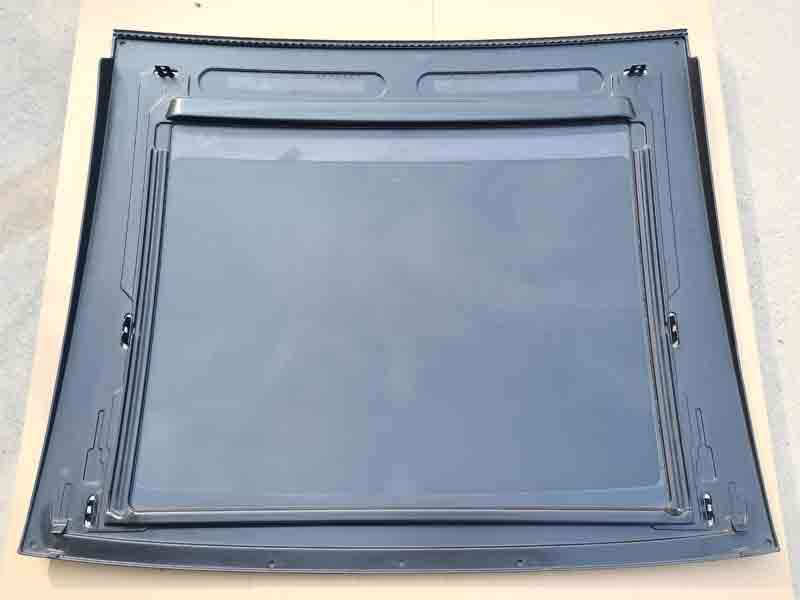
The bending strength test requires fixing the two ends of the glass, applying a uniform load at the center, and observing the deformation degree and maximum bearing capacity of the glass. The edge strength test simulates extrusion and collision during installation and detects whether the glass edge is easy to breaking.
According to industry standards, the bending strength of sunroof glass should be not less than 150MPa, and the edge compressive strength should be not less than 100MPa.
Some suppliers may use thinner glass or simplify the edge treatment process to reduce the cost, which may lead to easy fragmentation during installation or looseness due to bumps during vehicle driving.
The buyer shall require the supplier to provide the mechanical performance test report and conduct a manual pressing test during the sample acceptance to observe the deformation of the glass to ensure the stability and reliability of the structure after installation.
Sunroof Glass Chemical resistance test: the ability to resist corrosion and pollution
Automobile sunroof glass will come into contact with acid rain, bird droppings, oil stains, and other corrosive substances. Chemical resistance testing is an important link to ensure the appearance and lasting performance of products.
It is necessary to soak the glass in different concentrations of acid and alkali solutions or wipe it after applying simulated pollutants to observe whether the glass surface is corroded, discolored, or scratched.
After testing, qualified products should keep their surfaces clean, free from obvious corrosion traces, and free from residual stains after wiping.
Some low-priced products may not undergo surface strengthening treatment or adopt inferior coatings, which may easily cause surface damage after contact with corrosive substances, affecting the appearance and light transmission performance.
The purchaser shall require the supplier to provide a chemical resistance test report and conduct a simple acid-base wiping test at the time of sample acceptance to ensure that the product has good corrosion resistance.
As a professional supplier of sunroof, Houming sunroof has strictly completed the chemical resistance test of each batch of sunroof glass, which will provide a complete test report for the purchaser, and support the purchaser to conduct on-site sampling and test verification to ensure that each piece of glass delivered can meet the long-term use requirements.
Quality control is the embodiment of core competitiveness. By strictly requiring suppliers to complete the above five quality tests, not only can procurement risk be effectively reduced, but reliable products can also be provided to downstream customers, and a good brand image can be established.
FAQ
Q: What is the minimum order quantity of a supplier?
A: The order quantity for mainstream suppliers is 500-1000 pieces. Some customized products need to be negotiated to determine the order threshold.
Q: How long is the lead time for sunroof glass?
A: The delivery cycle of conventional products is 15-30 days, and the customized or special specifications need to be extended to 45-60 days.
Q: Does the supplier provide after-sales warranty service?
A: Regular suppliers usually provide a 12-month warranty, and some high-end products can be extended to 24 months, covering non-human-caused quality problems.