How to Fix a Leaking Car Sunroof
Many car owners will encounter the trouble of a leaking sunroof: the ceiling inside the car is leaking, and the carpet is wet, which not only affects the ride experience but also corrodes the interior and breeds mold for a long time. In fact, most of the sunroof leaks are minor problems, so there is no need to rush to the 4S shop to spend a lot of money on maintenance.
Today, Houming Sunroof will dismantle the four core repair steps for everyone, and you can solve the problem of sunroof leakage by yourself.
Step 1: Locate the source of the sunroof leakage and accurately investigate it without blindness.
In order to effectively solve the problem of sunroof leakage, the first step must be to find the source of leakage; otherwise, it will be useless. The common causes of sunroof leakage are mainly concentrated in four parts:
Aging of sealing strip
This is the most common reason. When the sunroof sealing strip is exposed to the sun for a long time, there will be problems such as cracking, hardening, and deformation, which will lead to lax sealing. You can touch the sealing strip by hand. If the surface is rough, cracked, or can’t rebound quickly after pressing, it means that the sealing strip needs to be replaced.
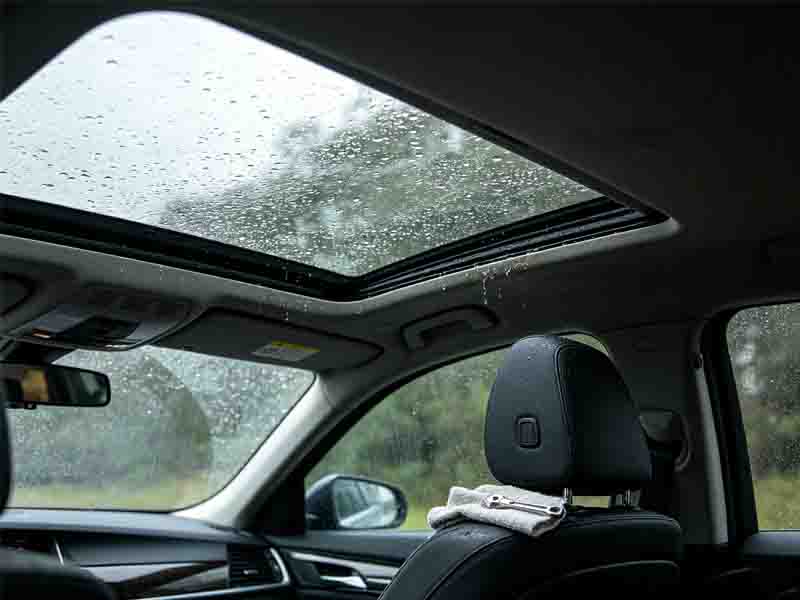
Drainage hole blockage
The edge of the sunroof is provided with a drainage hole, which is responsible for discharging rainwater outside the car. If you don’t pay attention to cleaning at ordinary times, leaves, dust, sediment, and other debris will block the drainage hole, resulting in rainwater not being discharged in time and then infiltrating into the car.
You can dredge the drain hole with thin wire or a high-pressure air gun. If a large amount of sundries are discharged, it means that the drain hole is the culprit of water leakage.
Deformation of sunroof frame
If vehicles have collided or driven on bumpy roads for a long time, the sunroof frame may be slightly deformed, resulting in a larger gap between the sunroof and the car body, and rainwater will take the opportunity to infiltrate.
You can observe the fit between the sunroof and the car body after closing the sunroof. If the gap is uneven, it means that the frame may be deformed.
Failure of sealant
If the sealant at the joint between the sunroof and the car body cracks and falls off, it will also lead to water leakage. You can carefully check the sealant around the sunroof. If there are obvious gaps or peeling marks, you need to reapply the sealant.
Step 2: Targeted repair to solve the core problem of the sunroof.
After finding the source of water leakage, targeted repair can be carried out. The repair methods for water leakage caused by different reasons are also different:
Replace the sealing strip: If the sealing strip leaks due to aging, it needs to be replaced with a new sealing strip. When replacing, first remove the old sealing strip, clean up the dirt on the edge of the sunroof, then install the new sealing strip in its original position, and press hard to ensure that the sealing strip is closely attached to the sunroof.
Pay attention to choosing the sealing strip that matches the vehicle model, so as to avoid untidy sealing due to inconsistent dimensions.
Dredge the drain hole: If the drain hole is blocked, it is necessary to dredge the drain hole. You can gently insert a thin wire into the drain hole to poke out the sundries, and then use a high-pressure air gun to blow out the remaining sundries in the drain hole.
After dredging, you can pour a small amount of water into the sunroof to observe whether the drainage is smooth. If the water flows out quickly, it means that the drainage hole has been dredged.
Correction of sunroof frame: If the water leakage is caused by deformation of the sunroof frame, it is necessary to correct the sunroof frame. Correcting the sunroof frame requires professional tools and techniques, and it is recommended that you go to a professional auto repair shop for processing. Don’t try to correct it yourself, so as not to aggravate the deformation of the frame.
Re-apply sealant: If the sealant fails to prevent water leakage, it needs to be re-applied. When smearing, clean up the old sealant first, then evenly smear a new sealant on the joint between the sunroof and the car body, and then close the sunroof after the sealant dries. Pay attention to the choice of high-temperature and aging-resistant sealant to ensure a lasting sealing effect.
Step 3: Do a good waterproof test to ensure the repair effect of the sunroof
After the repair is completed, the waterproof test must be carried out to ensure that the sunroof no longer leaks. You can use a high-pressure water gun to spray water on the sunroof to simulate rainy days, and then observe whether there is water seepage in the car.
If there is no water seepage in the car, it means that the repair is successful; If there is still water seepage in the car, it is necessary to re-investigate the source of water leakage and repair it again.
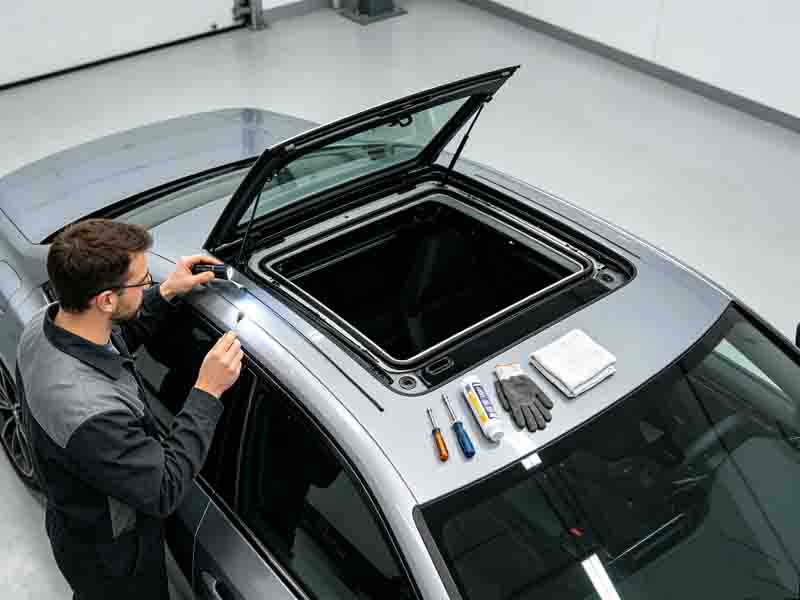
In addition to the high-pressure water gun test, you can also observe whether there is moisture in the car after rainy days, or put a paper towel in the sunroof, pour a small amount of water after closing the sunroof, and observe whether the paper towel is wet. These methods can help you to test the sealing effect of the sunroof.
Step 4: Daily maintenance to prevent the sunroof from leaking
Prevention is greater than a cure for the problem of water leakage in the sunroof. Daily maintenance can effectively avoid the occurrence of sunroof leakage:
Clean the sunroof regularly.
Regularly clean the dirt on the surface and edge of the sunroof to avoid debris blocking the drainage hole. You can wipe the surface of the sunroof with a soft cloth and clean the gap at the edge of the sunroof with a brush.
Check sealing strip
Check the condition of the sealing strip regularly, and replace it in time if it is found to be aging or cracked. You can apply a small amount of rubber protective agent to the sealing strip to delay the aging speed of the sealing strip.
Dredge the drainage hole
Regularly dredge the drainage holes to ensure smooth drainage. It is recommended to dredge the drainage holes every three months, especially before the rainy season.
Avoid violent operation
When opening and closing the sunroof, it should be opened and closed lightly to avoid the deformation of the sunroof frame or the damage to the sealing strip caused by violent operation.
Sunroof is an important configuration of vehicles, which can not only increase the lighting and ventilation effect in the car, but also improve the driving experience. As long as the daily maintenance is done and the leakage problem is repaired in time, the sunroof can always be kept in good condition.
FAQ
Q: Do I have to do a waterproof test after repairing the sunroof leakage?
A: Yes, after the repair is completed, the waterproof test can be done in time to confirm whether the water leakage problem is completely solved, so as to avoid water leakage again after loading and using, and it is more troublesome to disassemble and assemble repeatedly.
Q: How to do the waterproof test for the sunroof?
Answer: Park the vehicle in a flat area. After closing the sunroof, you can slowly pour the edge and drainage area of the sunroof with watering can or trickle water, and observe whether there are traces of water seepage at the seams of the ceiling and sunroof in the car. If there is no water seepage, it means that it is repaired in place.
Q: Is there anything else to pay attention to after the sunroof test?
Answer: After the test is completed, dry the residual water on the sunroof surface in time and keep the gap dry. As long as it is maintained regularly according to the daily maintenance requirements, the water leakage problem can be avoided for a long time.