Tempered vs Laminated Auto Sunroof Glass: What’s the Real Difference?
Under the dual trend of automobile lightweight and safety performance upgrade, the sunroof glass has changed from a simple comfort configuration to a core component that affects the safety and experience of the whole vehicle. Tempered glass and laminated glass, as the mainstream options in the current market, have essential differences in manufacturing technology, safety performance, service characteristics, and life cycle cost.
- Manufacturing process and structural differences between toughened and laminated sunroof glass of automobile sunroof
- Comparison of safety performance between tempered glass and laminated glass for sunroof
- Sound and heat insulation performance of tempered glass and laminated glass for sunroof: key differences in comfort
- Cost, weight and maintenance of tempered glass and laminated glass for sunroof: a comprehensive consideration from a practical point of view
Manufacturing process and structural differences between toughened and laminated sunroof glass of automobile sunroof
The most fundamental difference between tempered glass and laminated glass of sunroof is that their manufacturing technology and internal structure are completely different.
Tempered glass is made by heating ordinary annealed glass to near the softening point (about 650℃), and then cooling it quickly and evenly, so that a strong compressive stress layer is formed on the glass surface and a tensile stress is formed inside.
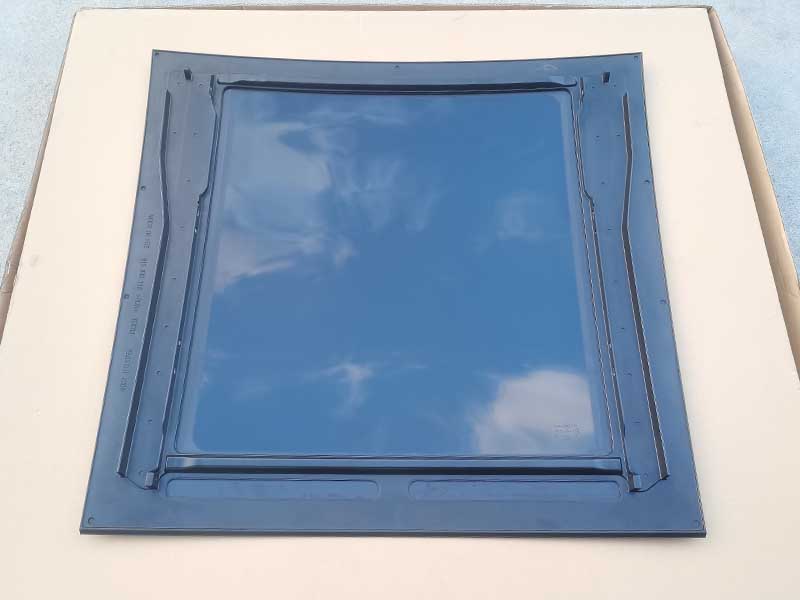
This stress state of “external pressure and internal tension” makes the bending strength and impact strength of tempered glass reach 4~5 times that of ordinary glass.
Laminated glass is completely different. It is made of two or more pieces of glass with a layer of PVB (polyvinyl butyral) or SGP (ionic intermediate film) sandwiched between them and laminated at high temperature and high pressure.
Even if the glass is broken by impact, the fragments will firmly adhere to the intermediate film and will not splash off. Laminated glass is a multi-layer composite structure, and the thickness combination of glass and intermediate film can be adjusted as needed to achieve different performance goals.
Comparison of safety performance between tempered glass and laminated glass for sunroof
Safety is one of the most important consideration indexes of sunroof glass, and the performance of two kinds of glass in safety performance has its own emphasis.
Tempered glass belongs to safety glass, and its safety logic is “no injury after breaking”. When the tempered glass is hit hard enough, it will break into numerous honeycomb-shaped obtuse-angle particles, which have no sharp edges and corners and are not easy to cut through the human body.
The impact strength of tempered glass is 4~5 times that of ordinary glass, and its thermal stability is also excellent, which can withstand the temperature difference of about 250~300℃.
The safety logic of laminated glass is “don’t fall off after breaking”. Even under strong impact, glass fragments will be firmly stuck by the PVB intermediate film and will not splash to hurt people. More importantly, PVB film has good toughness and penetration resistance.
When the vehicle rolls over, laminated glass can effectively prevent the passengers from being thrown out of the car, which tempered glass can’t do. Therefore, more and more car companies use laminated glass on the fixed panoramic canopy to improve the passive safety performance of the whole car.
Sound and heat insulation performance of tempered glass and laminated glass for sunroof: key differences in comfort
In addition to safety, the influence of sunroof glass on the comfort of the car can not be underestimated, especially in terms of sound insulation and heat insulation.
Sound insulation performance
The advantages of laminated glass are very obvious. PVB intermediate membrane is a viscoelastic material that can effectively absorb sound wave vibration and reduce sound propagation.
The research shows that the sound insulation effect of laminated glass is 3~5 decibels better than that of tempered glass with the same thickness. The laminated glass sunroof can significantly reduce wind noise and road noise, making the car quieter. Tempered glass has a single-layer structure, and its ability to block noise is relatively limited.
Heat insulation and ultraviolet blocking
Laminated glass also performs better. The PVB intermediate film itself can block more than 99% of ultraviolet rays and protect the interior seats, instrument panels, and other interiors from fading and aging due to the sun.
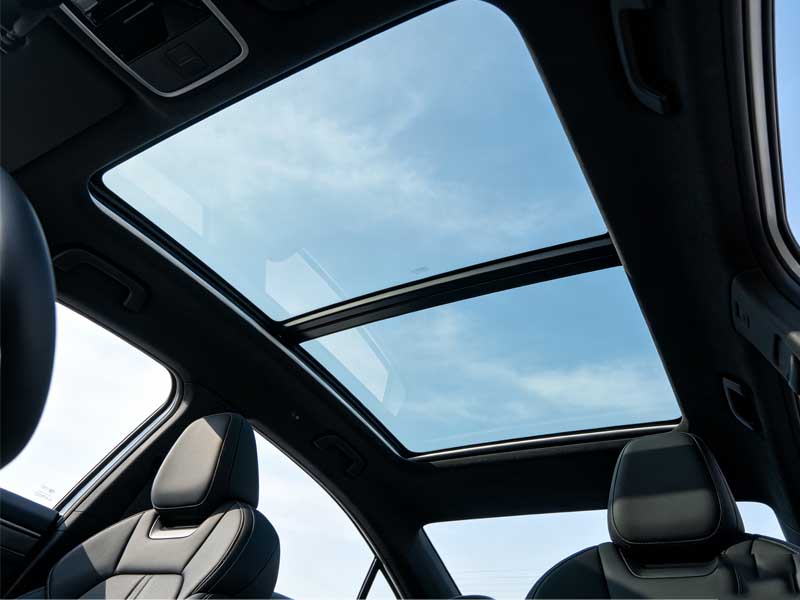
In addition, the laminated glass can also be added with thermal insulation coating or Low-E coating in the lamination process to further improve the thermal insulation effect. Although tempered glass can also improve its thermal insulation performance by sticking film, its effect is usually not as good as the original thermal insulation structure of laminated glass.
Cost, weight and maintenance of tempered glass and laminated glass for sunroof: a comprehensive consideration from a practical point of view
From the perspective of practical use, cost, weight and maintenance convenience are also factors that cannot be ignored.
Cost aspect
The production process of tempered glass is relatively mature, and the manufacturing cost is relatively low, so the price of vehicles equipped with tempered glass sunroofs is usually more affordable.
The cost of laminated glass is about 30%~50% higher due to the addition of PVB interlayer and a more complicated lamination process, which is one of the reasons why high-end models prefer to use laminated glass.
In terms of weight
Laminated glass is about 10%~15% heavier than tempered glass with the same thickness because it is a structure of two layers of glass and an intermediate film.
For new energy vehicles pursuing lightweight, this is a factor that needs to be weighed-heavier sunroofs mean higher energy consumption and lower body center of gravity.
Maintenance aspect
Two kinds of glass usually need to be replaced as a whole after being broken. However, because of its high strength but high brittleness, tempered glass is more likely to break when it is hit by local impact, such as stone splashing.
Sandwich glass, on the other hand, has stronger impact resistance and lower damage probability because of the buffering effect of the intermediate film. From the perspective of long-term maintenance cost, laminated glass is more durable, although the single replacement cost is higher, and the comprehensive cost may be lower.
FAQ
Q: What is the difference between the two kinds of glass in terms of heat insulation and ultraviolet blocking effect?
A: Ordinary tempered glass itself has a low blocking rate to ultraviolet rays, which can only block less than 20% of ultraviolet rays, and the heat insulation effect is relatively general. After long-term exposure, the temperature in the car is easy to rise, and it may also cause the interior and leather goods to age and faded by ultraviolet rays.
The laminated glass can block more than 99% ultraviolet rays by relying on the PVB film in the middle. At the same time, the PVB film can also effectively reduce infrared penetration and reduce heat entering the car. The heat insulation effect is far better than that of ordinary tempered glass, which can help reduce the energy consumption of air conditioning and delay the aging of the interior.
Q: Which is safer, tempered glass or laminated glass?
A: Laminated glass is safer. Although both of them belong to safety glass, the fragments of laminated glass will be stuck by the PVB intermediate film after impact, and will not splash off, and can effectively prevent passengers from being thrown out of the car when the car rolls over. Although the small particles with an obtuse angle are not easy to hurt people after being broken, the toughened glass will break and lose its protective effect.
Q: Can the sunroof glass be replaced separately after it is broken? Still need to change the assembly?
A: It is usually necessary to replace the sunroof assembly. Whether it is tempered glass or laminated glass, sunroof glass is integrated with the frame, sealing strip, guide rail, and other components, so it is difficult to ensure sealing and installation accuracy by replacing glass alone.