Automotive Sunroof Glass Installation Best Practices: Common Mistakes and How to Avoid Them
Installing the sunroof glass is an operation that requires extremely high precision. Improper operation will not only cause problems such as water leakage and abnormal sound, but also affect the structural stability of the sunroof and even the strength of the whole vehicle body. Mastering the correct installation process and avoiding common mistakes is the core to ensure the long-term stable use of the sunroof.
- Myth 1: Ignore the preparatory work for installing the sunroof and start work blindly.
- Myth 2: Improper use of sunroof sealant leaves a hidden danger of water leakage.
- Myth3: Inaccurate positioning of automobile sunroof glass leads to abnormal sound and dislocation.
- Myth4: Ignore the later debugging and testing of sunroof glass, and bury potential safety hazards.
Myth 1: Ignore the preparatory work for installing the sunroof and start work blindly.
Many installers are eager to get started when they get the sunroof glass, skipping the previous inspection and preparation work, which is the root cause of a series of subsequent problems. Common omissions include: incomplete cleaning of residual sealant, dust and debris in the sunroof frame; Did not check the matching degree between the glass model and the vehicle; Even the special tools needed for installation were not prepared in advance.

These seemingly insignificant small details will directly affect the installation effect. For example, the residual old glue on the frame will lead to the new sealant not being closely attached, which will bury the hidden danger of water leakage; Glass with different models may have a gap with the frame, which may cause annoying abnormal noise during driving.
Correct operation: Three core preparations must be completed before installation. First, use special adhesive remover and cleaning cloth to thoroughly clean all residues of the sunroof frame to ensure that the contact surface is clean and flat; Secondly, carefully check the model, size and drain hole position of the glass to ensure that it is completely consistent with the original specifications of the vehicle; Finally, prepare special sealant, torque wrench, positioning fixture and other tools to avoid operation errors caused by lack of tools.
Myth 2: Improper use of sunroof sealant leaves a hidden danger of water leakage.
Sealant is the key to waterproof sunroof, but in practice, the use of sealant often appears problems. For example, uneven application, local too thick or too thin; Or in order to save cost, use inferior sealant; Even after painting, the sunroof is closed immediately without waiting for enough curing time, resulting in the displacement of sealant.
These wrong operations will directly damage the waterproof performance of the sunroof. When it is rainy or washing the car, rainwater will seep into the car along the gap, soak the interior, corrode the circuit, and even affect the electronic system of the car.
Correct operation: Choose neutral silicone sealants that meets the original vehicle standard. This kind of sealant has good weather resistance and adhesion, and can adapt to different temperature and humidity environments. When daubing, it should be uniform and uniform, and ensure that the sealant is continuous without breakpoints, and the thickness should be controlled between 3-5mm. After the application is completed, it is necessary to wait for enough curing time (usually 24 hours) according to the sealant instructions, and avoid touching or moving the glass during this period to ensure the sealant is fully formed.
Myth3: Inaccurate positioning of automobile sunroof glass leads to abnormal sound and dislocation.
The positioning accuracy of sunroof glass is directly related to the use experience. Many installers only judge the position with the naked eye, or do not use special positioning tools, which causes the glass to be installed askew and not tightly attached to the frame. In this case, when the vehicle is running, the glass will rub or collide with the frame, making a harsh noise, which will wear the glass edge and the frame for a long time and shorten the service life of the sunroof.
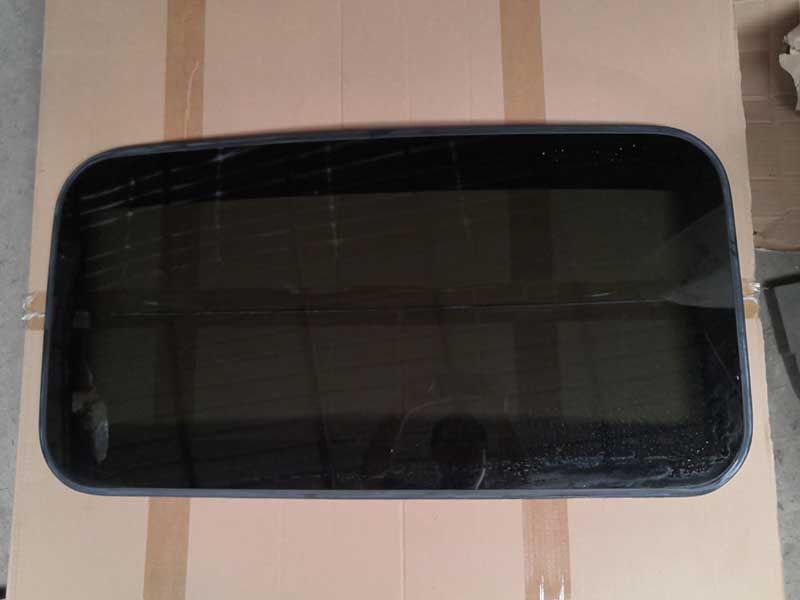
Correct operation: During installation, a special positioning fixture must be used to accurately fix the glass at the position marked by the original factory, so as to ensure that the gap between the glass and the frame is uniform (usually 2-3mm). In the process of fixing, use a torque wrench to tighten the fixing screws in turn according to the specified torque value (generally 5-8 N m) to avoid the glass deformation caused by uneven force. After the installation is completed, open and close the sunroof several times to check whether the glass moves smoothly, whether it is stuck or abnormal, and ensure accurate positioning.
Myth4: Ignore the later debugging and testing of sunroof glass, and bury potential safety hazards.
Many people think that everything will be fine after the glass installation is completed, ignoring the later debugging and testing links. For example, the drainage system of the sunroof is not checked, the anti-pinch function is not tested, and the sealing performance of the glass is not confirmed. These hidden problems may not be exposed until they are used for a period of time. At that time, maintenance will not only cost more, but also affect driving safety.
Correct operation: After installation, four key tests must be completed. First of all, open the sunroof drainage hole, rinse it with clear water, and observe whether the drainage is smooth and blocked; Secondly, test the anti-pinch function of the sunroof, simulate obstacles with special test tools, and check whether the sunroof can stop or run in reverse in time; Then, carry out a water spray test, spray around the sunroof with a high-pressure water gun, and observe whether there is water leakage in the car; Finally, check the torque values of all fixing screws again to ensure that there is no looseness. Only by passing all tests can the sunroof be confirmed to be qualified.
FAQ
Q: Before installing the sunroof glass, what preliminary preparations must not be ignored?
A: First of all, it is necessary to check whether the model and size of the new glass are suitable for the vehicle to avoid wrong installation; Secondly, it is necessary to clean up the aging sealant, dirt and rust left on the sunroof frame in advance to ensure that the installation surface is flat and clean, so that the new glass can fit more closely; In addition, it is necessary to prepare the matching fixing parts, sealant and other installation materials in advance, check whether the tools are complete, and start work after confirming that the vehicle is powered off to avoid circuit failure during operation.
Q: Is it normal for the sunroof glass to have slight wind noise after installation?
A: Wind noise occurs after the sunroof glass is installed, which is usually related to the height difference between the glass and the roof. If the glass is installed too high (flush with the roof or protruding), the airflow will generate turbulence when passing by, which will cause wind noise.
Q: The sunroof glass has just been installed. How long will it take for the customer to wash the car or open and close the sunroof?
A: It is recommended to wait at least 24 hours, preferably 48 hours, after the installation, before washing the car or operating the sunroof.